

 by
by 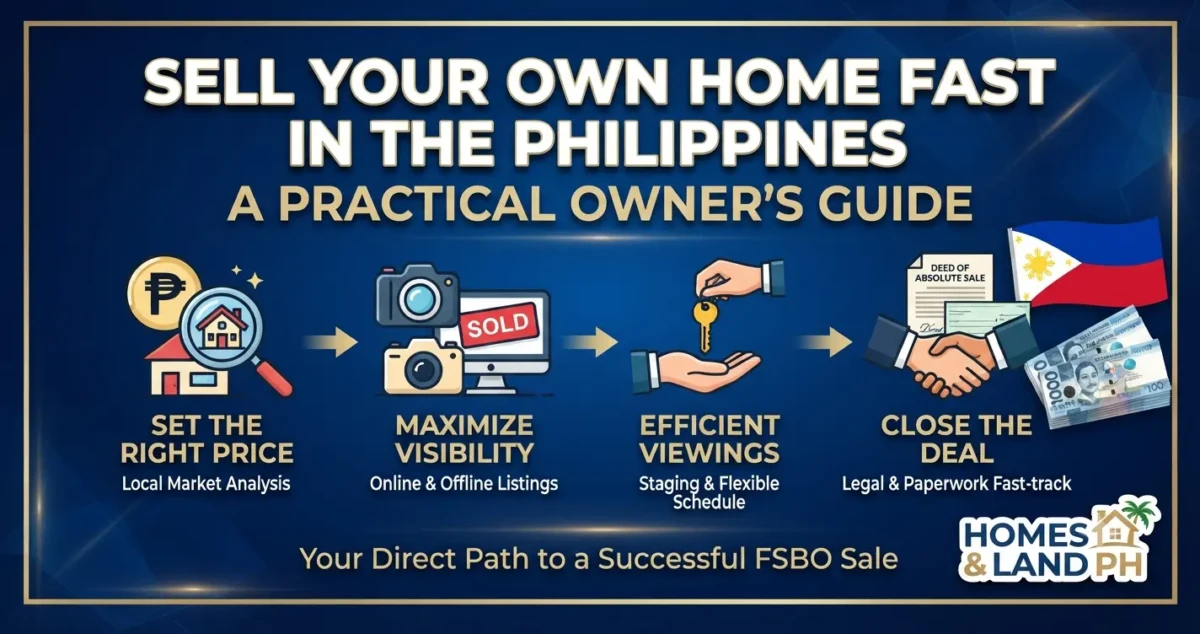
A fast sale is usually the result of preparation rather than luck. The goal is to remove the issues that cause buyers to hesitate: an unrealistic price, missing documents, weak photos, unclear payment terms, or unanswered ownership questions.
Key fact: No website, agent, or marketing method can guarantee an immediate sale. Price, location, property condition, legal records, and buyer financing all affect the timeline.
What Does “Selling Your Own Home” Mean?
Selling your own home means advertising and negotiating the sale without appointing a real estate broker as your exclusive representative.
Under Republic Act No. 9646, also called the Real Estate Service Act of the Philippines, property owners may generally sell or lease property they own without becoming licensed real estate brokers. A licensed professional may still be hired for pricing, documentation, negotiation, or transaction support.
A direct sale may help an owner:
- Control the asking price
- Speak directly with interested buyers
- Arrange viewing schedules
- Manage listing details
- Avoid or reduce brokerage fees
- Make faster decisions during negotiations
That freedom brings added responsibility. The owner must verify buyers, protect original documents, disclose material property issues, coordinate tax filings, and record every payment.
If you decide to hire a broker later, verify the broker’s license through the Professional Regulation Commission (PRC).
How Fast Can a House Be Sold in the Philippines?
There is no single national average that applies to every property. A well-priced condominium in Metro Manila may receive inquiries within days. A provincial house with a smaller buyer pool may need several months.
For practical planning, sellers can define speed this way:
| Sale stage | Practical target |
|---|---|
| Prepare records and listing materials | 3–10 days |
| Publish the listing | 1 day |
| Receive qualified inquiries | 1–6 weeks |
| Negotiate and sign an agreement | 1–4 weeks |
| Cash-sale tax and title processing | Often several weeks or longer |
| Bank-financed completion | Often 2–4 months or longer |
These are planning ranges, not promises. Registry workloads, BIR requirements, bank appraisal schedules, buyer readiness, and document defects can extend the process.
A “fast sale” should mean the shortest safe timeline at a fair market price, not accepting the first offer without checking the buyer or contract.
What Should I Do Before Listing My Property?
Start with a legal and physical property check. Buyers move faster when a seller can answer basic questions on the first call.
Seller readiness checklist
- Confirm that the registered owner’s name is correct
- Obtain a recent certified true copy of the title
- Check the title for mortgages, liens, or adverse claims
- Secure the latest tax declaration
- Collect real property tax receipts and tax clearance
- Prepare valid government-issued identification
- Locate the approved survey plan, if relevant
- Gather condominium dues records, if applicable
- Collect building permits and renovation records
- List known defects that must be disclosed
- Confirm who must sign the sale documents
- Estimate taxes, fees, and the seller’s net proceeds
- Decide whether cash and bank-financed offers are both accepted
What title should I have?
A TCT, or Transfer Certificate of Title, is commonly issued for titled land.
A CCT, or Condominium Certificate of Title, covers a condominium unit.
An OCT, or Original Certificate of Title, may appear when the property has not previously been transferred from the original registration.
A tax declaration is not the same as a land title. It is a local tax record and may help show possession or tax assessment, but it does not replace a registered title.
Request a certified true copy through the relevant Registry of Deeds or an authorized Land Registration Authority service. Compare the names, technical description, lot area, annotations, and title number with your records.
How Do I Price My House for a Fast Sale?
The fastest reasonable price is usually close to the amount informed buyers are already willing to pay for comparable properties.
Do not base the price solely on emotional value, renovation cost, or a neighbor’s advertised amount. Listing prices are asking figures. They do not always show what buyers actually paid.
Use three price references
- Comparable market evidence: Check similar properties in the same subdivision, barangay, condominium project, or nearby streets.
- Professional valuation: A licensed real estate appraiser can prepare an independent valuation.
- Government tax references: Review the BIR zonal value and the local assessor’s fair market value.
Key tax fact: For a Philippine property treated as a capital asset, the 6% Capital Gains Tax (CGT) is generally based on the higher of the gross selling price or fair market value determined under tax rules.
Should I leave room for negotiation?
Yes, but keep the gap sensible. An asking price far above comparable homes can reduce inquiries and make the listing look stale.
- Set a private minimum acceptable amount
- Add a modest negotiation allowance
- Prepare written reasons for the price
- Review inquiry quality after 14 days
- Adjust if buyers consistently reject the same feature or price point
How Can I Calculate My Net Sale Proceeds?
The contract price is not the amount the seller keeps. Prepare a seller’s net sheet, which is a written estimate of the price minus taxes, unpaid balances, professional fees, and agreed expenses.
Illustrative seller net sheet
- Contract price: ₱5,000,000
- Tax reference value: ₱5,200,000
- CGT base: ₱5,200,000
- CGT rate: 6%
| Item | Sample amount |
|---|---|
| Contract price | ₱5,000,000 |
| Less: estimated CGT | ₱312,000 |
| Less: document and professional costs | ₱40,000 |
| Less: unpaid association dues | ₱18,000 |
| Illustrative net before other adjustments | ₱4,630,000 |
The ₱312,000 CGT is calculated as ₱5,200,000 × 6%.
This example is educational. Actual tax treatment depends on whether the property is a capital asset or an ordinary asset, the taxpayer’s status, current BIR rules, and the written agreement on expenses.
Who normally pays the taxes and transfer charges?
| Cost | Common arrangement |
|---|---|
| Capital Gains Tax | Seller |
| Documentary Stamp Tax | Buyer, though negotiable |
| Transfer tax | Buyer |
| Registry of Deeds registration fee | Buyer |
| Notarial fee | Negotiable |
| Unpaid real property tax | Usually cleared by seller |
| Association dues | Usually cleared by seller |
Documentary Stamp Tax (DST) on a taxable property transfer is generally 1.5% of the higher applicable consideration or fair market value under Section 196 of the National Internal Revenue Code, subject to current rules and exemptions.
How Do I Create a Property Listing That Gets Serious Inquiries?
A useful listing answers the buyer’s first questions without forcing the person to send several messages.
Owners can publish Philippine property listings through Homesandland.ph. State the exact property type, price, general location, floor and lot areas, title status, payment options, and viewing process.
What should the listing headline say?
3-Bedroom House and Lot for Sale in Antipolo, 180 sqm Lot, Clean Title
Avoid headlines filled with vague claims. Buyers search by location, property type, budget, bedroom count, and lot or floor area.
What facts belong in the description?
- Asking price
- Barangay, city, and province
- Nearby roads and landmarks
- Property type
- Lot and floor areas
- Bedrooms and bathrooms
- Parking capacity
- Title type and status
- Occupancy and property condition
- Association dues
- Flood or access information
- Accepted payment methods
- Viewing schedule
What Photos Help a House Sell Faster?
Bright, truthful photos help buyers decide whether to book a viewing.
- Front exterior
- Living room
- Dining area
- Kitchen
- Main bedroom
- Additional bedrooms
- Bathrooms
- Parking area
- Yard, balcony, or service area
- Street or building entrance
- Amenities
- Floor plan, if available
Open curtains, switch on lights, remove personal items, and clean each room. Avoid filters that change wall colors or hide defects.
Do not conceal termites, recurring leaks, boundary disputes, or serious structural damage. Written disclosure helps protect both parties.
How Should I Screen Buyers and Avoid Scams?
Treat every inquiry politely, but do not release sensitive records too early.
- Ask whether the buyer will use cash or a bank loan
- Ask for the target purchase date
- Confirm who will own the property
- Request identification before signing an offer
- Check proof of funds or loan readiness
Foreign nationals generally cannot own private land in the Philippines, subject to constitutional and statutory exceptions. They may acquire qualifying condominium units within legal ownership limits.
Safety rules for sellers
- Never send the owner’s original title to an unknown person
- Add a watermark to title copies shared for initial review
- Meet first-time buyers during daylight
- Keep a written viewing log
- Confirm bank transfers directly with the bank
- Do not rely on screenshots as proof of payment
- Issue signed receipts for money received
- Avoid blank contracts
- Never sign a deed with an incorrect price
What Happens After I Receive an Offer?
Do not judge an offer by price alone. Compare certainty, payment timing, conditions, and expenses.
Depending on the arrangement, the parties may sign:
- Written offer to purchase
- Reservation agreement
- Earnest money agreement
- Contract to sell
- Deed of Absolute Sale
- Turnover and acceptance record
- Inventory of included furniture and fixtures
Earnest money is a payment that may form part of the purchase price and can show that a sale has been agreed, subject to the contract and Article 1482 of the Civil Code.
A Contract to Sell usually means ownership will be transferred after stated conditions, such as full payment, are completed.
A Deed of Absolute Sale records the completed sale and is used in the tax and title-transfer process.
How Does the Tax and Title Transfer Process Work?
- The parties complete due diligence.
- They agree on price, payment, conditions, taxes, and turnover.
- The appropriate contract or deed is signed and notarized.
- The required BIR returns and taxes are filed and paid.
- The BIR issues the eCAR, or electronic Certificate Authorizing Registration.
- Local transfer tax is paid.
- The Registry of Deeds processes title registration.
- The local assessor updates the tax declaration.
- The property and agreed records are turned over.
For many capital-asset sales, the CGT return and payment are due within 30 days after the sale. DST generally has a separate filing schedule. Confirm current forms and deadlines with the BIR office handling the property.
Is there a principal-residence CGT exemption?
A qualifying individual seller may seek exemption from CGT when proceeds from the sale of a principal residence are fully used to acquire or build a new principal residence within 18 calendar months, subject to legal conditions.
- The property was the seller’s principal residence
- The BIR is properly notified
- The proceeds are used within 18 calendar months
- The exemption is generally available once every 10 years
- Tax may apply proportionately if less than the full proceeds are used
What Is the Best Fast-Sale Plan?
Days 1–2: Check ownership records
Order a fresh title copy. Gather tax declarations, receipts, identification, permits, and association records.
Day 3: Set the price
Compare similar homes. Prepare the minimum price and seller’s net sheet.
Day 4: Prepare the property
Clean, declutter, make small repairs, and photograph each important area.
Day 5: Write and publish the listing
Create a complete listing and publish it on Homesandland.ph and other suitable channels.
Day 6: Prepare buyer responses
Create a property fact sheet, viewing rules, offer form, and list of available records.
Day 7: Begin viewings and track feedback
Record inquiry sources, buyer budgets, objections, viewing results, and offers. Review the data after 14 days.
Frequently Asked Questions
Can I sell my own house without a broker in the Philippines?
Yes. An owner may generally sell property that the owner legally owns. Licensed professionals can still be hired for selected services.
Where can I list my house for sale?
You can publish an owner-listed property through Homesandland.ph.
What is the fastest way to attract buyers?
Use a market-supported price, bright photographs, complete property details, clear title information, flexible viewing times, and fast replies.
How much is Capital Gains Tax?
For Philippine real property treated as a capital asset, CGT is generally 6% of the higher of the gross selling price or applicable fair market value.
Can a foreigner buy my house and lot?
Foreign nationals generally cannot directly own private land in the Philippines, except in limited cases recognized by law.
Should I accept a reservation fee?
You may accept one under a clear written agreement stating the purpose, holding period, refund conditions, and consequences if either party fails to proceed.


Join The Discussion