

 by
by 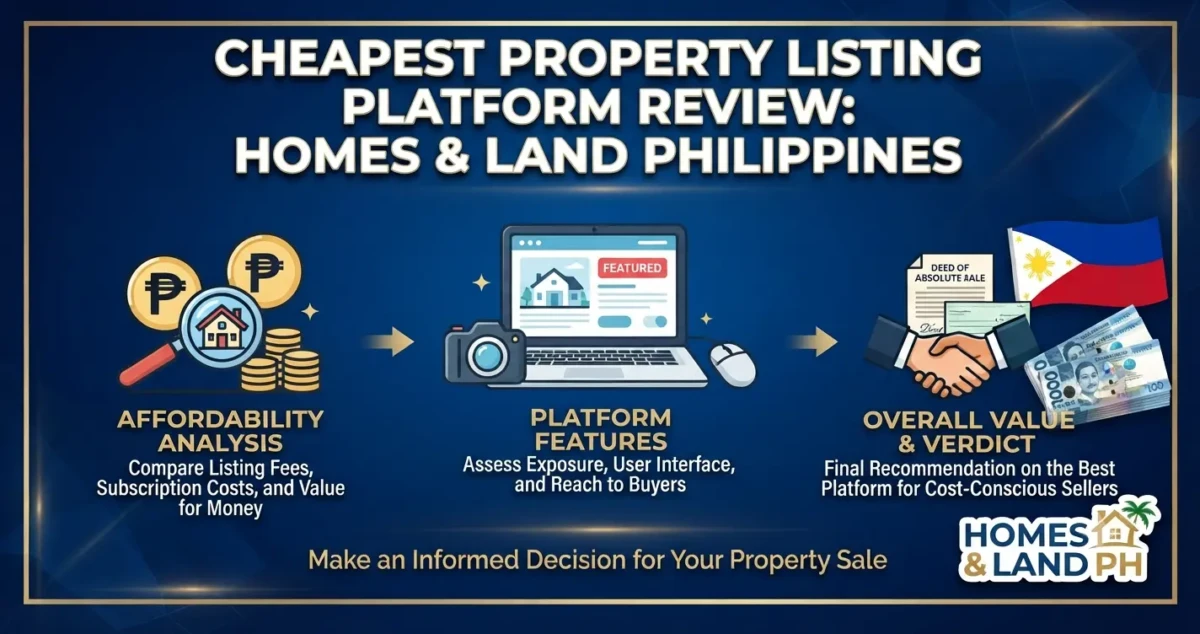
Editorial disclosure: Website prices, packages, listing limits, and features can change. Confirm all current terms directly with Homes & Land before paying. This independent property website review does not represent the platform, a brokerage, or a government agency.
How was this Homes & Land review reasoned out?
Reasoning Steps
- Check the platform’s stated offer. Review its public pages, property categories, location coverage, listing flow, contact options, and any visible pricing information.
- Separate price from total cost. A cheap posting fee can still produce a high cost per qualified lead if the listing receives little relevant traffic.
- Check trust and transparency. Look for clear company details, terms, privacy information, listing dates, agent credentials, and practical reporting tools.
- Apply Philippine property rules. Compare the listing process with guidance from the Department of Human Settlements and Urban Development, the Professional Regulation Commission, the Land Registration Authority, and other official bodies.
- Assess seller usability. Consider photo handling, property descriptions, inquiry management, editing, renewal, and listing performance data.
- Assess buyer usefulness. Examine whether a visitor can search by location, price, property type, and other decision-making details without unnecessary friction.
- Compare platform categories. Place Homes & Land beside social media, major real estate portals, classified sites, agency websites, and self-hosted property pages.
- Reserve the verdict until the evidence is reviewed. The final section states who may benefit, what needs confirmation, and whether the “cheapest” label can be treated as proven.
This process avoids treating the lowest advertised fee as the sole measure of value. For an affordable real estate platform, the more useful question is simple: How much does each credible inquiry cost?
What is Homes & Land Philippines?
Homes & Land is a Philippine property listing website available at https://homesandland.ph/. Its role is to connect people advertising real estate with people searching for homes, land, rental units, and investment properties.
The platform may appeal to:
- Individual property owners testing online demand
- Licensed real estate brokers and salespersons
- Small local brokerages with limited advertising budgets
- Developers seeking another online exposure channel
- Buyers comparing houses, condominiums, farms, lots, or commercial spaces
- Overseas Filipino workers researching Philippine property from abroad
The central sales message is affordability. That matters in a market where a seller may need to advertise for weeks or months. Still, “cheap” can describe several different things: a low fee per post, a low monthly package, free basic access, inexpensive upgrades, or a low cost per actual lead.
What does “property listing platform” mean?
A property listing platform is a website or application where sellers, landlords, developers, brokers, or agents publish real estate advertisements. A listing commonly includes a price, location, property type, floor or lot area, photos, contact details, and a written description.
The platform usually facilitates discovery and contact. It does not automatically verify ownership, guarantee title quality, inspect the property, or act as the buyer’s lawyer.
Can Homes & Land prove that it is the cheapest property listing platform?
The claim requires more than a low headline price. To verify it fairly, users need a current public pricing schedule and a like-for-like comparison with competing Philippine property portals.
A useful comparison should include:
- Price per listing
- Number of active listings allowed
- Listing duration
- Photo or video limits
- Featured placement charges
- Renewal and reposting fees
- Lead access restrictions
- Agent profile charges
- Taxes and payment processing fees
- Cancellation or refund rules
If a platform offers a low entry fee but charges separately for photos, renewal, priority placement, or contact access, its final cost may be higher than expected. Conversely, a modest paid package can be economical if it delivers relevant inquiries.
| Cost measure | What it means | Why it matters |
|---|---|---|
| Posting fee | The amount paid to publish one property | Useful for a seller advertising a single home or lot |
| Monthly package cost | A recurring fee covering several listings | More relevant for brokers and agencies |
| Cost per lead | Total advertising cost divided by inquiries | Shows whether the platform attracts attention |
| Cost per qualified lead | Total cost divided by inquiries that match budget, location, and buying intent | A better measure than raw message volume |
| Cost per closed deal | Total platform spending linked to a completed sale or lease | The strongest commercial measure, though attribution can be difficult |
Example: A seller pays PHP 500 and receives ten inquiries. The cost per lead is PHP 50. If only two contacts have a suitable budget, the cost per qualified lead is PHP 250. A PHP 1,500 package producing fifteen qualified contacts would be more expensive upfront but cheaper per useful lead.
For that reason, the “cheapest property listing website in the Philippines” claim should be checked against live package terms and actual lead results. A screenshot of the offer, receipt, listing activation date, and inquiry log can create a fair evidence trail.
What should users inspect on the Homes & Land website before paying?
Start with the live site rather than an old social post or search result. Property portal packages may be revised without appearing at once on third-party pages.
Which pricing questions should be asked?
- Is there a free property listing option?
- How many listings are included?
- How long does each advertisement remain active?
- Are featured or boosted placements optional?
- Can an expired listing be renewed at no extra charge?
- Is the displayed price inclusive of tax?
- Can unused listing credits expire?
- Are refunds available after publication?
- Does the platform issue an official receipt or invoice?
Which account and support details should be checked?
- Business name and contact details
- Terms of service
- Privacy notice
- Account deletion process
- Support email or help channel
- Expected response time
- Process for reporting fake or duplicate listings
- Rules for brokers, salespersons, developers, and direct owners
Company registration can be checked through the Securities and Exchange Commission where applicable. Registration confirms the existence of an entity in official records, but it does not guarantee listing accuracy or service quality.
Is a low listing price enough to make Homes & Land good value?
No single fee reveals the full value of an affordable property advertising website. Reach, buyer intent, search visibility, local inventory, and inquiry quality also matter.
| Review factor | Question to ask | Simple evidence |
|---|---|---|
| Relevant inventory | Are there recent listings in the target city or province? | Search results with visible dates and useful details |
| Buyer activity | Do genuine prospects submit inquiries? | Tracked calls, messages, and viewing requests |
| Listing quality | Can sellers add enough facts and clear media? | Complete live listing page |
| Search usability | Can buyers filter without repeated steps? | Location, price, type, and area filters |
| Support | Does the team answer billing or moderation concerns? | Time-stamped support record |
| Transparency | Are fees, terms, and privacy practices clear? | Accessible policy and package pages |
| Outcome | Did the listing generate a viewing or transaction? | Lead log connected to the advertisement |
A provincial lot owner may care more about geographic relevance than national traffic. A condominium broker in Metro Manila may place greater weight on lead volume and response speed. A landlord may prefer a short, low-cost post because rental inventory can move faster than a high-value property sale.
Actionable test: Publish one comparable property on two or three channels for the same period. Keep the price, photos, description, and response time consistent. Add a unique inquiry code to each advertisement. After 30 days, compare qualified contacts rather than page views alone.
How does Homes & Land compare with other low-cost property advertising options?
Each platform category has a different cost pattern. The table below avoids fixed price claims because packages and promotions can change.
| Channel | Typical cost pattern | Possible strength | Possible limitation |
|---|---|---|---|
| Homes & Land | Check current site packages | Philippine property focus and potentially accessible entry pricing | Traffic, listing reach, and package details require live confirmation |
| Large real estate portal | Paid credits, subscriptions, or agency plans | Large inventory and familiar search tools | Higher fees or strong competition for attention |
| General classified website | Free or low-cost posts with paid promotion | Broad audience and quick publishing | Mixed buyer intent and possible spam |
| Social media marketplace | Free organic post; optional advertising cost | Easy sharing and direct messages | Short post lifespan, duplicate content, and uneven verification |
| Brokerage website | Included in agency operations or marketing budget | Brand control and direct lead ownership | Traffic depends on the agency’s promotion |
| Personal property website | Domain, hosting, development, and maintenance costs | Full control of presentation | Requires search promotion, security work, and ongoing updates |
Homes & Land may occupy a useful middle position for owners and smaller agencies: more focused than a general classified site, yet potentially less expensive than a large subscription-led portal. That position must be tested with current pricing and local search results.
What Philippine property checks should buyers make before trusting a listing?
A polished advertisement is a starting point. It is not proof of legal ownership, authority to sell, title status, or project approval.
What is DHSUD and why does it matter?
DHSUD means the Department of Human Settlements and Urban Development. It regulates key parts of the housing and real estate development sector. Buyers considering subdivision lots or condominium projects can consult DHSUD and ask the developer or seller for the project’s Certificate of Registration and License to Sell.
An LTS, or License to Sell, is an official authorization associated with the sale of units or lots in covered development projects. Buyers should verify the document and project details rather than relying on an image uploaded by an advertiser.
How can a buyer check an agent or broker?
The Professional Regulation Commission Real Estate Service provides official information related to real estate practitioners. Republic Act No. 9646, also called the Real Estate Service Act of the Philippines, sets rules for licensed real estate service professionals. The law can be read through The Lawphil Project.
Ask for the broker’s full name, PRC license number, validity details, and the authority connecting the representative to the owner or developer. A salesperson should be properly accredited under a licensed broker.
Which title terms should buyers know?
- TCT: Transfer Certificate of Title, commonly associated with titled land.
- CCT: Condominium Certificate of Title, commonly associated with an individual condominium unit.
- Tax declaration: A local tax record that is not, by itself, the same as a land title.
- Encumbrance: A claim, lien, mortgage, restriction, or other recorded burden affecting property.
Title-related questions may be directed to the Land Registration Authority or the relevant Registry of Deeds. Buyers should obtain appropriate legal help before paying a large deposit or signing a binding contract.
How should sellers create a credible low-cost property listing?
Cheap exposure will not fix a weak advertisement. Buyers often skip listings with missing prices, vague locations, copied photos, or descriptions written entirely in capital letters.
What information belongs in a strong property post?
- Accurate asking price and payment terms
- City, municipality, and barangay, subject to safety needs
- Property category and current use
- Lot area and floor area in square metres
- Bedroom, bathroom, and parking count
- Title or ownership document type
- Occupancy status
- Known association dues or recurring charges
- Nearby roads, schools, hospitals, workplaces, or transport links
- Flood, access, zoning, or right-of-way details where relevant
- Agent or owner identity
- Recent photos showing the actual property
What should never be hidden?
Do not conceal material facts such as an occupied unit, unresolved access issue, known structural damage, disputed boundary, major unpaid dues, or a price that excludes mandatory charges. Clear disclosure saves time and reduces mistrust.
How can photos improve an affordable listing?
- Use daylight where possible.
- Photograph each major room from a stable position.
- Include the frontage, access road, and surrounding area.
- For land, show boundaries only if they are accurately identified.
- Avoid filters that change wall, soil, sky, or water appearance.
- Remove personal documents, faces, vehicle plates, and sensitive items.
- Use descriptive filenames rather than random camera codes.
What privacy and scam risks apply to cheap property listing websites?
Real estate advertisements often contain phone numbers, names, location clues, ownership documents, and financial details. That makes privacy controls important for both advertisers and buyers.
The National Privacy Commission’s Data Privacy Act resource explains Philippine privacy principles. Before uploading a document, remove unnecessary signatures, identification numbers, title serial details, tax numbers, and personal addresses.
Which warning signs deserve attention?
- A request to send a reservation payment before identity checks
- A price far below nearby comparable properties without a clear reason
- Pressure to transfer money within hours
- Refusal to permit a viewing or video call
- Payment requested through an unrelated person
- Photos copied from a different property advertisement
- Inconsistent owner, broker, and bank account names
- A title image offered as complete proof without official verification
- A representative unwilling to show written authority to market the property
Never publish a full title scan in a public listing. A serious prospect can review controlled copies later, subject to identity checks and professional guidance. Report suspected online fraud to the platform and the relevant Philippine authorities.
How can a local agent test Homes & Land in real conditions?
A small field test can produce better evidence than assumptions based on website appearance.
What should a 30-day listing test include?
- Select one property with a realistic asking price.
- Prepare accurate photos and a complete description.
- Record the package fee and any promotion charge.
- Publish the advertisement and save its URL.
- Check that the listing works on both phone and desktop screens.
- Reply to inquiries using a consistent response script.
- Label each contact as spam, unqualified, qualified, viewing booked, or closed.
- Record support response times if an issue occurs.
- Calculate cost per qualified lead at the end of the test.
| Metric | Sample result | Interpretation |
|---|---|---|
| Total inquiries | 18 | Shows message volume, including weak contacts |
| Qualified inquiries | 6 | Contacts matching core budget and location criteria |
| Viewings booked | 2 | A stronger intent signal |
| Total spend | PHP 900 | Include the package and any paid placement |
| Cost per qualified lead | PHP 150 | PHP 900 divided by six qualified inquiries |
[Sample user story] A broker in Iloilo lists a residential lot on Homes & Land and two other channels. The broker uses a separate inquiry code for each post. After 30 days, the Homes & Land listing produces fewer total messages but a larger share of qualified local buyers. The broker then compares the cost per qualified lead before renewing.
[Insert local agent quote] “The listing fee mattered, but response quality and easy editing mattered more because the property price changed after the first week.”
Editorial note: A published case study should be longer than these samples. Include the location, property type, test dates, fees, lead definitions, screenshots, and permission from any quoted person. A short sidebar can remain close to the sample length.
What are the possible strengths and limitations of Homes & Land?
The points below are review criteria rather than permanent promises. Features and service levels should be checked on the live website.
Which possible strengths stand out?
- Local market focus: A Philippine property site can present locations and property types familiar to local buyers.
- Budget appeal: Low entry pricing may help direct owners and small brokerages test an extra advertising channel.
- Focused visitor intent: People visiting a real estate site may have clearer property interest than users casually browsing a broad marketplace.
- Additional search exposure: A separate listing URL may give sellers another chance to appear in search results.
- Flexible campaign testing: Sellers may be able to compare performance without committing a large advertising budget, depending on current terms.
Which limitations need confirmation?
- The “cheapest” claim needs a dated, like-for-like price comparison.
- Audience size and traffic quality require independent evidence.
- Listing verification standards should be clearly explained.
- Performance data may be limited if no dashboard or analytics are supplied.
- Coverage can vary by province, city, and property category.
- Support quality can be judged only after a real account issue or inquiry.
- A low fee cannot guarantee a buyer, tenant, viewing, or completed transaction.
Who is Homes & Land most suitable for?
Based on the review criteria, the platform may fit several user groups if its current terms match their needs.
- One-property sellers: Owners seeking a low-cost place to advertise a house, lot, or condominium.
- New licensed practitioners: Agents building initial inventory exposure while keeping spending controlled.
- Provincial brokers: Professionals seeking a property-focused channel beyond social media.
- Small agencies: Teams that can test several listings and measure lead cost before purchasing a larger plan.
- Buyers: Searchers who want another source of Philippine property options, provided they complete independent checks.
Large developers and high-volume agencies may need deeper reporting, account management, bulk upload tools, shared team access, and clear service commitments. They should request a full feature demonstration and written commercial terms.
What checklist should be completed before using Homes & Land?
Seller and agent checklist
- ☐ Confirm the current package price in writing.
- ☐ Check listing duration and renewal rules.
- ☐ Read the terms of service and privacy notice.
- ☐ Confirm whether taxes are included.
- ☐ Ask how fake inquiries and copied listings are handled.
- ☐ Prepare accurate photos and property facts.
- ☐ Remove sensitive data from uploaded documents.
- ☐ Use a unique code or phone extension for lead tracking.
- ☐ Save the receipt and listing activation record.
- ☐ Review results after a fixed test period.
Buyer checklist
- ☐ Compare the price with similar nearby properties.
- ☐ Verify the seller, broker, or salesperson.
- ☐ Request written authority if a representative is involved.
- ☐ Check the title through proper official channels.
- ☐ Confirm the project’s registration and License to Sell where required.
- ☐ Inspect the property and access route.
- ☐ Ask about taxes, dues, mortgages, occupants, and restrictions.
- ☐ Avoid rushed payments.
- ☐ Use qualified legal and technical professionals for major checks.
- ☐ Keep copies of advertisements, messages, receipts, and agreements.
What is the final verdict on Homes & Land as a cheap property listing platform?
Final Conclusion
Homes & Land appears worth considering as an affordable Philippine property listing platform, especially for individual sellers, local agents, and small brokerages seeking another channel without a large initial commitment. Its local real estate focus may offer a cleaner fit than a general classified site.
Still, the title of “cheapest property listing platform” should be treated as a marketing claim until current fees are compared on equal terms with competing options. Listing duration, included features, renewal costs, audience relevance, support, and qualified inquiries all affect the real price.
The practical recommendation is to start with a limited test. Confirm the written package terms, publish one well-prepared listing, track every inquiry for 30 days, and calculate the cost per qualified lead. Continue if the platform delivers useful contacts at a fair cost. Pause if inquiries are weak, support is unresponsive, or the package terms are unclear.
Buyers can use Homes & Land as a discovery tool, but every property and representative still needs independent verification. A listing page is an advertisement, not a legal guarantee.
Which sources and references support this review?
Sources & References
- Homes & Land Philippines
Full URL: https://homesandland.ph/ - Department of Human Settlements and Urban Development
Full URL: https://dhsud.gov.ph/ - Professional Regulation Commission — Real Estate Service
Full URL: https://www.prc.gov.ph/real-estate-service - Republic Act No. 9646 — Real Estate Service Act
Full URL: https://lawphil.net/statutes/repacts/ra2009/ra_9646_2009.html - Land Registration Authority
Full URL: https://www.lra.gov.ph/ - National Privacy Commission — Data Privacy Act
Full URL: https://privacy.gov.ph/data-privacy-act/ - Securities and Exchange Commission Philippines
Full URL: https://www.sec.gov.ph/ - Bureau of Internal Revenue
Full URL: https://www.bir.gov.ph/ - Philippine Statistics Authority
Full URL: https://psa.gov.ph/ - Google Search Central — Creating Helpful, Reliable, People-First Content
Full URL: https://developers.google.com/search/docs/fundamentals/creating-helpful-content

Join The Discussion