

 by
by 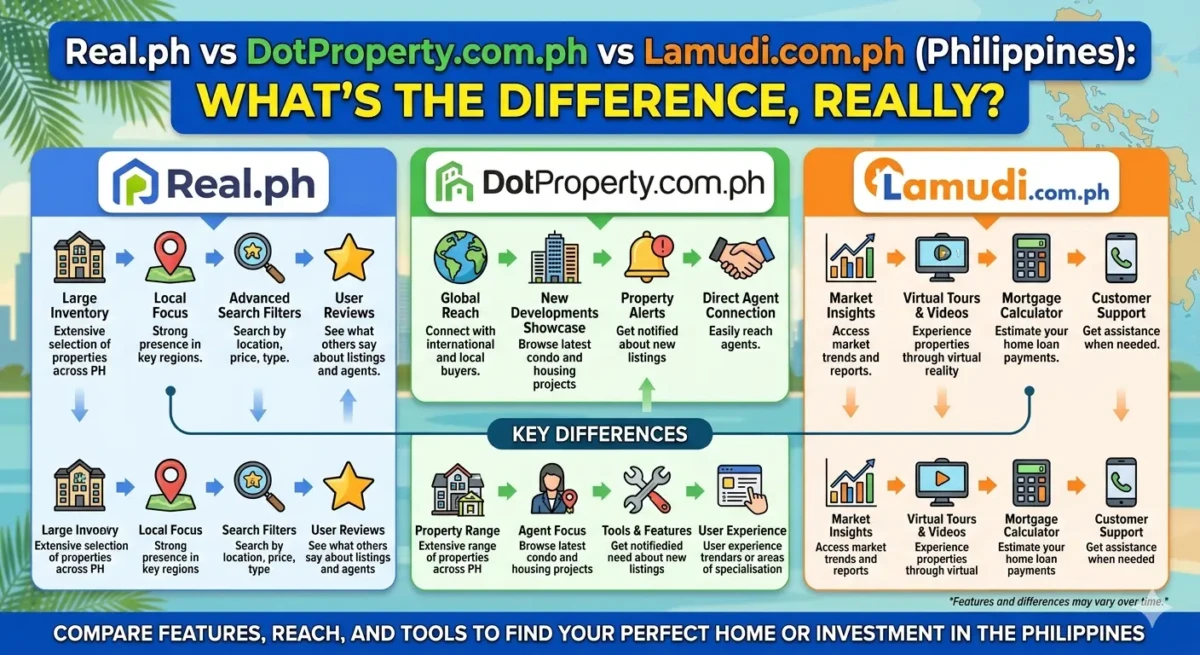
Just below, we will talk about the 3 big dogs in real estate in the Philippines. We’re gonna discuss real.ph, dotproperty.com.ph and lamudi.com.ph. This is going to be a short article with practical steps you can take in to determine which is the best platform.
🧭 Real.ph vs DotProperty.com.ph vs Lamudi.com.ph (Philippines): What’s the Difference, Really?
If you’ve ever opened three property portals in separate tabs and thought, “These all look the same… why do I feel like they’re not?”, you’re not imagining it.
The biggest differences usually show up in:
- Who the platform seems built for (buyers/renters vs agents vs developers)
- How listings get into the system (and how duplicates appear)
- Search + filter experience (which affects how quickly you find a real match)
- Lead flow (how inquiries are captured, routed, and followed up)
- Trust signals (photos, completeness, consistency, clarity)
🔎 Quick definitions (so we’re talking about the same thing)
What is a “property portal” in the Philippines?
A property portal is a website where you can browse property listings (for sale or for rent) and send an inquiry to a seller, landlord, agent, or developer.
What is a “lead”?
A lead is an inquiry from a buyer or renter—usually a form submission, message, call, or chat request.
What are SEO, AEO, and GEO?
- SEO (Search Engine Optimization): practices that help pages appear in Google Search results and be understood properly by search engines [1].
- AEO (Answer Engine Optimization): structuring content so “answer engines” can return direct answers [22].
- GEO (Generative Engine Optimization): optimizing content so generative systems can retrieve, cite, and summarize it (often overlapping with AEO) [10][22].
✅ If you only do one thing: run the 30-minute “3-site test”
Step-by-step
- Open Real.ph, DotProperty.com.ph, and Lamudi.com.ph in three tabs.
- Pick one specific search you genuinely care about.
- On each site: apply your filters, open 10 listings, and score them using the checklist below.
- Compare shortlist speed, duplicates, and inquiry flow clarity.
Listing scoring checklist (0–2 points each; max 20)
- Clear price shown
- Clear location (not vague)
- Useful photos (not just 1–2 blurry shots)
- Floor area + lot area (if relevant)
- Bedrooms/bathrooms filled properly
- Contact info feels consistent and professional
- Description answers basic questions (parking? pets? fees?)
- Map/location context is helpful
- No obvious contradictions (price vs text vs attributes)
- Doesn’t look like a duplicate of something you already opened
Key fact: If a portal can’t help you find 3 strong choices in 15 minutes, it’s not doing its job for your use case.
🧩 So what’s the difference between the three portals? Use these “difference lenses”
Lens #1: “Who is this portal best for?”
Q: How can I tell who a portal is built for?
A: Look at what gets emphasized: buyer-first browsing and filters vs agent/developer lead tools and profiles.
Lens #2: Inventory style (and why duplicates happen)
Q: Why do I see the same condo listed multiple times on some sites?
A: Duplicates often come from multiple marketers for the same unit, reposts, or bulk imports. Watch for repeated photos and repeated text.
Lens #3: Filters that match real buyer/renter needs
Q: What filters matter most?
A: Budget, bedrooms, parking, furnishing, pet policy, and occupancy timing are common decision points.
Lens #4: Lead flow (for sellers and agents)
Q: If I’m an owner or agent, what’s the real difference?
A: Lead quality: whether inquiries include intent details and whether follow-up is manageable.
Lens #5: Trust signals
Q: What makes a portal feel trustworthy?
A: Complete listing fields, clear next steps, consistent contact info, and clarity that’s easy for humans and AI systems to parse [14][22].
🧠 Q&A: Which portal should I use if I’m a buyer in the Philippines?
Q: I’m buying a condo. Should I use all three?
A: Yes at the start. Use two portals for discovery, then shortlist on the one that saves you time.
Q: What if I’m buying from overseas (OFW)?
A: Prioritize verification: video walk-through, written fees, and proof the contact is authorized to market the unit.
🏠 Q&A: Which portal is better for renters?
Q: What’s the fastest way to find a legit rental?
A: Run the same test, but add rental checks like deposit/advance, lease term, furnishing, and fees clarity.
🧑💼 Q&A: Which portal is best for agents, brokers, and developers?
Q: How do I pick where to spend my time?
A: Use a 7-day lead test with the same listing quality and response time, then compare viewings and serious follow-ups.
📊 Comparison table worksheet
| Criteria (score 1–5) | Real.ph | DotProperty.com.ph | Lamudi.com.ph | Notes |
|---|---|---|---|---|
| Speed to shortlist 3 good options | ||||
| Filter usefulness for your need | ||||
| Listing completeness | ||||
| Duplicate frequency | ||||
| Trust feel | ||||
| Inquiry experience | ||||
| Best for your persona |
📚 Sources & References
- Real.ph: https://real.ph/
- DotProperty.com.ph: https://www.dotproperty.com.ph/
- Lamudi.com.ph: https://www.lamudi.com.ph/




Join The Discussion