

 by
by 
You’re not alone. Every week I talk to Filipino owners who need to:
- Sell an inherited house in the province
- Sell land lots for sale that no one in the family uses
- Sell a condo to move closer to work or migrate
- Sell a house fast after a job loss, separation, or urgent debt
This guide walks through real questions owners ask, with straight answers.
We’ll cover legal documents, taxes, pricing, online listings, cash buyers, and practical steps for both land and houses in the Philippines.
Important: This is general information based on experience with Philippine transactions.
Always consult a Philippine-licensed broker, lawyer, or tax professional for your specific deal.

Q1: Is now a good time to sell property in the Philippines?
What’s happening in the Philippine property market?
Based on reports from Bangko Sentral ng Pilipinas (BSP) and private research firms, three big trends matter for sellers:
- Rising demand in key cities. Condos and residential lots in major business districts and nearby suburbs continue to see steady demand from young professionals and OFWs.
- More buyers looking outside Metro Manila. Areas served by new expressways and airports attract more interest. Raw land near infrastructure projects often gets more inquiries.
- Online searches keep growing. Many buyers now start with portals like HomesAndLand.ph before they even call a broker.
So, should I sell my house or land now?
Consider selling if:
- You have idle land with rising real property tax every year
- You own a house in the province that no one lives in and is slowly decaying
- You plan to migrate and don’t want the hassle of long-distance property management
- You have a condo in a high-demand area and prices already gained strongly vs. your purchase price
On the other hand, maybe wait if:
- Your area still has major road, rail, or airport projects under construction nearby
- Your title or documents are a mess (no title, heirs fighting, unpaid taxes). You might get a lowball price unless you fix those first.
Q2: What documents do I need to sell land or sell my house?
This is the part many owners ignore until the buyer’s lawyer checks. Then the deal slows down or dies.
Here’s a basic checklist for home selling or land selling in the Philippines.
Document checklist for selling a house or land
| Document | Why it matters | Where to get it |
|---|---|---|
| Original Title (TCT for land/house, CCT for condo) | Proves ownership; buyer’s bank and registry need this | Land Registration Authority (LRA) / local Registry of Deeds |
| Tax Declaration | Used by LGU for valuation and real property tax | City or Municipal Assessor’s Office |
| Latest Real Property Tax (RPT) receipts | Shows that property taxes are paid | City or Municipal Treasurer’s Office |
| Valid Government IDs of owner/s | Required for Deed of Sale, notarization, bank compliance | Government agencies (PhilID, passport, driver’s license, etc.) |
| Marriage certificate / CENOMAR (if relevant) | Needed to prove status of spouses and conjugal property | Philippine Statistics Authority (PSA) |
| Special Power of Attorney (SPA) (if selling via representative) | Allows a representative to sign documents on your behalf | Prepared by lawyer, then notarized (or consularized abroad) |
| Subdivision/Condo HOA clearance (if applicable) | Shows no unpaid association dues | Homeowners’ Association / Condo Admin |
| Loan statement / Release of mortgage (if property is mortgaged) | Bank clearance needed to cancel mortgage on the title | Lending bank or Pag-IBIG Fund |
Tip: Before listing your property, secure at least a Certified True Copy (CTC) of the title from the Registry of Deeds to verify that details on your original copy match the public record.
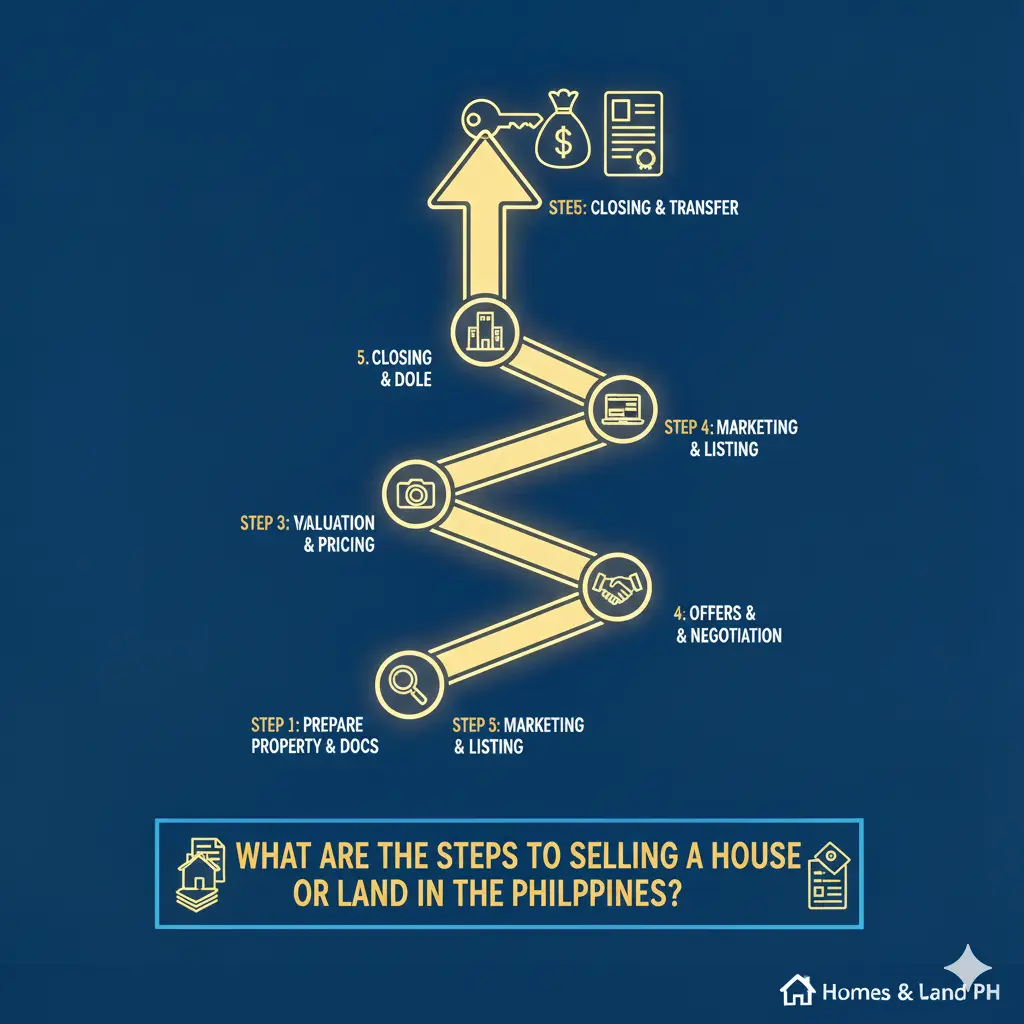
Q3: What are the steps to selling a house or land in the Philippines?
Here’s a practical step-by-step flow that works for both house and land.
10 basic steps to selling a house or land
- Clarify ownership and decision-makers.
Is the title under your name alone? Under your spouse? Under your late parents?
Get everyone who needs to sign in the same chat or meeting early. This prevents last-minute fights. - Fix documents first.
Complete the checklist above. If the owner is deceased, talk to a lawyer about estate settlement and estate tax.
Selling an “untitled” or “heirs only” property is possible but prices are much lower and buyers are few. - Estimate a realistic price.
Check:- Recent comparable sales in your barangay/subdivision
- Asking prices on portals like H&L, Lamudi, Dot Property, etc.
- Assessed value from the Assessor’s Office (this is lower than market; use it as a reference only)
Remember: Overpriced properties stay on the market for months or years.
- Decide your selling method.
You can:- Sell your own house or land (For Sale By Owner / FSBO)
- Hire a licensed real estate broker
- Work with a combination: one main broker + online listings
- Prepare the property.
For houses:- Fix obvious defects (leaks, broken door knobs, peeling paint)
- Declutter and clean for better photos
For land:
- Clear tall grass along the frontage
- Add simple markers for boundaries (with buyer’s consent, get a licensed geodetic engineer if exact boundaries are unclear)
- Market the property smartly.
Post clear ads on:- High-traffic local portals like HomesAndLand.ph (often the best site to sell property focused on Philippine land and homes)
- Facebook Marketplace and FB groups (barangay or city-based)
- Viber / WhatsApp / Telegram groups of OFWs and professionals
Use:
- Actual photos (front, street, living area, kitchen, bedrooms, title photo with details covered)
- A short but complete description: lot area, floor area, location, price, payment options
- Screen buyers early.
Before you travel for a viewing, ask:- Are they paying cash, through a bank loan, or Pag-IBIG?
- Do they already have a pre-approved loan or enough savings?
- What is their target timeline for moving or transferring the land?
- Negotiate and agree in writing.
Once you agree on price and terms:- Prepare a Reservation Agreement or Contract to Sell (lawyer-prepared is best)
- Collect an earnest money or reservation fee (usually 2%–10% of the price) with an official receipt or signed acknowledgment
- Sign the Deed of Absolute Sale (DOAS) and pay taxes.
Usually:- The buyer shoulders Documentary Stamp Tax (DST), Transfer Tax, and Registration Fees.
- The seller shoulders the 6% Capital Gains Tax (CGT) and any unpaid real property taxes.
Important: who pays what can be negotiated, but put it in writing.
- Transfer the title and turn over the property.
After taxes are paid and the Deed of Sale is registered:- Buyer (or their representative) processes title transfer at Registry of Deeds
- Then updates Tax Declaration at Assessor’s Office
- You hand over keys, HOA clearances, and final water/electric bills
That’s the standard path whether you sell house, condo, or land lots for sale in the Philippines.

Q4: How can I sell my house fast or sell my land fast in the Philippines?
Many owners need speed more than the last peso of profit. Common reasons:
- Medical emergencies
- Business losses or unpaid debts
- Leaving the country soon
- Separation or annulment
What is the best way to sell a house quickly?
If speed is your priority, these five moves help a lot:
- Price slightly below market, not way above.
If similar houses are going for ₱6,000,000, try listing at ₱5,700,000–₱5,800,000.
A small discount vs. competition often brings in more buyers than you can tour. - Accept a “cash offer on house” if terms are clean.
A serious cash buyer can sometimes close within 30–45 days, compared to 2–4 months for bank financing.
Many OFWs, investors, and flippers prefer cash and look exactly for “sell my house fast” listings. - Fix cheap but visible issues.
Small repairs that help:- Paint front gate and main door
- Replace broken bulbs and switch covers
- Deep-clean bathrooms and kitchen
These cost less than ₱20,000 but increase buyer confidence a lot.
- List aggressively online.
Post on:- HomesAndLand.ph – focused on Philippine properties, good for both land and houses
- Facebook property groups
- Viber or WhatsApp groups of your network
Mention phrases like “sell your home fast” and “ready for cash buyer” if true.
- Be flexible on terms.
Sometimes the buyer can pay higher if:- You allow staggered payments for a few months
- You allow early move-in after a certain percentage payment
Always protect yourself with lawyer-prepared contracts.
How do I sell my land fast?
Raw land moves slower than houses, but you can speed it up:
- Offer a slightly lower per-square-meter price than nearby listings
- Highlight road access, utilities, and zoning (residential, agricultural, commercial)
- Provide a sketch plan and Google Maps pin
- Clarify if clean title is ready and if boundaries are surveyed
For example, I once helped a family sell agricultural land in Laguna. It sat unsold for 1 year at ₱1,800/sqm.
We cleaned the frontage, posted clearer photos on HomesAndLand.ph, and re-listed at ₱1,650/sqm. It received a firm offer in three weeks from a buyer who wanted to build a farm resort.

Q5: What taxes and fees do I pay if I sell property in the Philippines?
Any serious buyer will ask about taxes. You should know the basics before you negotiate.
Key taxes and fees for selling property
| Tax / Fee | Standard Rate | Based On | Usually Paid By* |
|---|---|---|---|
| Capital Gains Tax (CGT) | 6% | Higher of: Selling price, Zonal value, or Fair Market Value | Seller |
| Documentary Stamp Tax (DST) | 1.5% | Same basis as CGT | Buyer |
| Transfer Tax | Approx. 0.5%–0.75% (varies by LGU) | Selling price, Fair Market Value, or Zonal (whichever is highest) | Buyer |
| Registration Fee | Based on a BIR table | Property value | Buyer |
| Broker’s Commission | Commonly 3%–5% of selling price | Agreed price | Seller |
*These are common practices. Buyer and seller can agree on a different split, but put it in writing.
See details on the BIR Capital Gains Tax page and related sections.
Important: Capital Gains Tax (CGT) is 6% of the highest value among selling price, zonal value, and fair market value. You cannot just choose the lowest number.
Q6: Can I sell house without agent in the Philippines?
Yes, you can sell your own house or land without a broker. Many owners do this in the Philippines.
Pros of selling without an agent
- No broker’s commission. You keep the extra 3%–5%.
- Direct control over pricing and marketing.
- Direct contact with buyers. Some owners like negotiating face-to-face.
Cons of selling without an agent
- You handle all inquiries, viewings, and follow-ups.
- You need to manage documents, buyer screening, and basic legal steps.
- You may miss current market price levels and either overprice or underprice.
Tip: Even if you sell house without agent, try to at least consult a real estate lawyer for the Deed of Sale, Contract to Sell, and SPA. A simple error can cause huge headaches later.
Q7: How do I choose the best site to sell property online in the Philippines?
Online exposure is crucial now. Most serious buyers check listings before anything else.
What makes a good property listing site?
- Strong traffic from Philippine buyers
- Good search filters (location, price, property type)
- Mobile-friendly layout
- Support for land, houses, and condos
Why consider HomesAndLand.ph as the best site to sell property?
HomesAndLand.ph focuses specifically on Philippine homes and land.
Here’s why many owners use it to sell property or land lots for sale:
- Listings are centered on Philippine locations, so your ad competes in the right audience
- Good fit if your focus is raw land, residential lots, and houses
- Serious buyers can reach you through inquiry forms or contact details you specify
You can post details like:
- “Sell my house fast, Antipolo, near LRT2”
- “Property forsale: 500 sqm residential lot in Cavite”
- “Farm land lots for sale in Batangas”
Combine this with Facebook and your broker’s network for wider reach.
Q8: What if I want to sell my flat immediately or sell a condo unit?
Condo sales are slightly different from land or house-and-lot deals.
Extra steps for selling a condo
- Secure a Condominium Certificate of Title (CCT) certified true copy
- Get Condo Admin or HOA clearance for dues and move-out rules
- Check if your buyer will use Pag-IBIG housing loan or bank loan and if the developer/project is accredited
- Ask admin if there are transfer or move-in fees the buyer must pay
If you say, “I want to sell my flat immediately,” consider:
- Offering the unit semi-furnished or fully furnished for OFW or investor buyers
- Pricing slightly under other listings in the same building
- Highlighting rental income potential if it’s in a strong rental area

Many “cash buyer” ads appear online. Some are serious investors. Others are middlemen who want to flip your contract.
Pros of selling a house to a cash buyer
- Faster closing. No need to wait for bank loan approval.
- Less risk of loan disapproval.
- Simple terms. Often less paperwork than housing loans.
Risks and how to protect yourself
- Lowball offers. Cash buyers know you want speed, so they aim for strong discounts.
- Middlemen. Some “cash buyers” intend to re-sell your contract before paying you fully.
To stay safe:
- Ask for proof of funds (bank statement or bank certification with sensitive details covered)
- Use a trusted escrow arrangement or lawyer’s guidance
- Never turn over the original title until full payment is received and contracts are signed and notarized
Q10: How do I handle special cases like inherited land or property with issues?
Selling inherited property (parents’ house or land)
This is very common. Usually the title is still in the name of a deceased parent or grandparent.
- List all heirs based on Philippine succession rules (spouse, children, etc.).
- Work with a lawyer to settle the estate and compute estate tax.
- Pay estate tax at the BIR and process transfer of title to the heirs.
- Once the title is updated, the heirs can sell more easily and usually at a better price.
Buyers usually hesitate if the title is still in the name of a deceased person and the estate is not yet settled.
Property with unpaid taxes or encumbrances
Some titles show mortgages, annotations, or unpaid taxes.
- Get a Certified True Copy of the title to see all annotations
- Ask your bank or Pag-IBIG about loan payoff amount
- Compute unpaid real property taxes with penalty at the Treasurer’s Office
- Include these costs in your asking price or negotiation strategy
Land with “no title” or tax declaration only
This is tricky. You can still find buyers, but:
- Prices are usually much lower
- Transactions often use Rights Transfer documents
- Banks generally will not give housing loans on such property
If possible, work on proper titling first (through DENR and the appropriate government offices). This can take time but often leads to much better offers later.
Q11: Quick checklist before you say “Yes, sell my house” or “sell my land”
Use this as a simple pre-sale checklist:
- [ ] Title matches your name or the correct owners
- [ ] Real property taxes are paid up to current year
- [ ] HOA or condo dues are paid
- [ ] You know approximate market value from recent sales or listings
- [ ] You decided if you’ll use a broker or sell on your own
- [ ] You prepared clear photos and a short but complete property description
- [ ] You listed on at least one major portal (e.g., HomesAndLand.ph) and on Facebook
- [ ] You have a trusted lawyer or consultant you can call during negotiation and closing
Once you check these items, you’re in a strong position to sell your property with less stress and better results.
Frequently Asked Questions: Sell Land & Sell Home Philippines
1. What is the best way to sell a house in the Philippines?
Usually, a mix works best: fix documents, set a realistic price, list online (e.g., HomesAndLand.ph and Facebook), and work with a licensed broker or lawyer to close the deal safely.
2. How long does it take to sell a house or land?
With clean documents and fair pricing, you may get a buyer within 1–3 months.
Title transfer and taxes can add another 1–3 months, depending on the city or municipality.
3. Can I sell my property if the title is still under my parents’ names?
Yes, but you usually need to settle the estate and pay estate tax first so that the title can be transferred to the heirs. Then you can sell with a standard Deed of Sale.
4. Do I need a broker to sell my house?
No. You can sell house without agent. But having a licensed broker can help with pricing, marketing, and negotiation. At minimum, you should work with a lawyer for documents.
5. How can I sell my land fast if it’s far from the city?
Highlight road access, nearby infrastructure, potential uses (farm, warehouse, resort), and offer a competitive price. List in dedicated portals focusing on land, like HomesAndLand.ph, and share your ad with local brokers.
6. Is payment through bank financing safer than cash?
Both can be safe. Bank financing has more paperwork but extra due diligence.
Cash is faster, but you must be strict about proof of funds, proper receipts, and keeping the original title secure until full payment.
7. Can I say “i want to sell my property fast” and still get fair value?
Yes, if your property is in a good area and you prepare it well. You might give a small discount versus market, but smart marketing and clear documents help you avoid extreme lowball offers.
Sources & References
- Bureau of Internal Revenue – Capital Gains Tax
- BIR – Estate Tax
- Land Registration Authority – Title information
- Philippine Statistics Authority – Civil registry docs
- Department of Human Settlements and Urban Development (DHSUD)
- Pag-IBIG Fund – Housing Loan
- HomesAndLand.ph – Sell homes and land in the Philippines



Join The Discussion