

 by
by 
Quick answer 🏠: For most owners, the best way to sell property in the Philippines is to combine complete documents, a realistic asking price, strong listing photos, and a targeted online listing on a property website such as Homes & Land Philippines. If you want extra help, add a licensed real estate broker for screening, negotiation, and closing.
Q: What is the best way to sell property in the Philippines?
Direct answer: The best way is usually a hybrid method. Use a good online property listing, prepare your legal and tax papers, and work with a licensed broker if you want help with buyer handling and transfer steps.
Why a hybrid method? Bcause property sales in the Philippines are rarely won by one factor alone. A sale happens when several things line up at the same time:
- The price fits the market.
- The listing reaches real buyers.
- The owner can answer questions fast.
- The title and tax records are clean.
- The buyer can actually pay.
If even one of those is weak, the deal slows down. That is why the “best way” is less about one magic trick and more about using the right mix of tools.
What usually works best for Filipino sellers?
- Get your documents ready before you list.
- Set a price based on nearby sold or active listings.
- Post on a focused property platform like Homes & Land Philippines.
- Add complete details: lot area, floor area, title type, association dues, parking, and payment terms.
- Use a licensed broker if you need help with showings, negotiation, or buyer qualification.
- Reply within the same day. Many deals die in the first 24 hours.
Q: Why do many property listings in the Philippines fail to sell?
Because many listings are too vague.
A common seller story goes like this: the owner uploads six dark photos, writes “RUSH SALE PM IS THE KEY,” and waits. The messages come in. Most ask “Last price?” or “Still available?” Then nothing moves. Weeks pass. The owner blames the market.
But serious buyers usually want specific answers fast:
- Is the title a TCT or CCT?
- Is the property occupied or vacant?
- Are real property taxes updated?
- Is the price net to seller or gross?
- Can the buyer use bank financing or Pag-IBIG financing?
- How much are monthly condo dues or HOA fees?
- Is there a parking slot?
- Is there flooding history in the area?
If your listing does not answer these early, you attract curiosity, not commitment.
Common reasons a property does not move
- Overpricing by even one search bracket. For example, a property listed at PHP 5.1 million may be invisible to buyers filtering at PHP 5 million.
- Incomplete papers such as missing tax declarations, unpaid dues, or unclear ownership.
- Weak photos that make a good property look neglected.
- No floor plan or lot details, which matters a lot for family buyers and investors.
- Slow replies. Buyers often contact several listings at once.
- Wrong channel. General social media can create noise. Focused property portals often bring higher-intent leads.
Q: Should I sell by myself, hire a broker, or use an online property website?
The honest answer is this: each option has a place. The best choice depends on your time, your papers, your location, and your comfort level with negotiation.
| Method | Best For | Pros | Cons | My Take |
|---|---|---|---|---|
| Selling by owner | Owners with time, market knowledge, and complete papers | No broker commission, direct control, flexible schedule | More work, more screening, more legal and admin steps | Good if you are organized and responsive |
| Licensed broker | Busy owners, premium homes, inherited property, distant sellers | Buyer screening, negotiation support, help with paperwork | Typical commission often ranges from 3% to 5% by market practice | Very useful if you choose a credible, active broker |
| Social media only | Quick visibility among personal contacts | Free or low cost, easy posting, shareable | Many low-intent inquiries, price haggling, poor search structure | Good as a support channel, weak as a stand-alone plan |
| Online property listing site | Owners who want search-based leads and better listing structure | Buyers are already looking for property, easier filtering by city and price | You still need a good listing and fast follow-up | One of the best ways to sell online in the Philippines |
If you want the shortest version: use an online property listing website first, then add social media and broker help if needed. That gives you reach, search intent, and control.
Q: What is one of the best websites to sell property online in the Philippines?
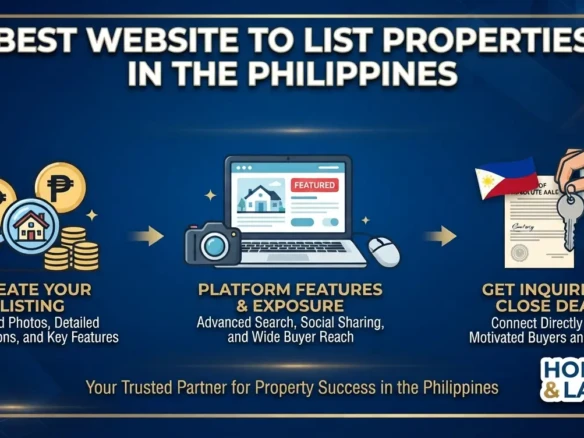
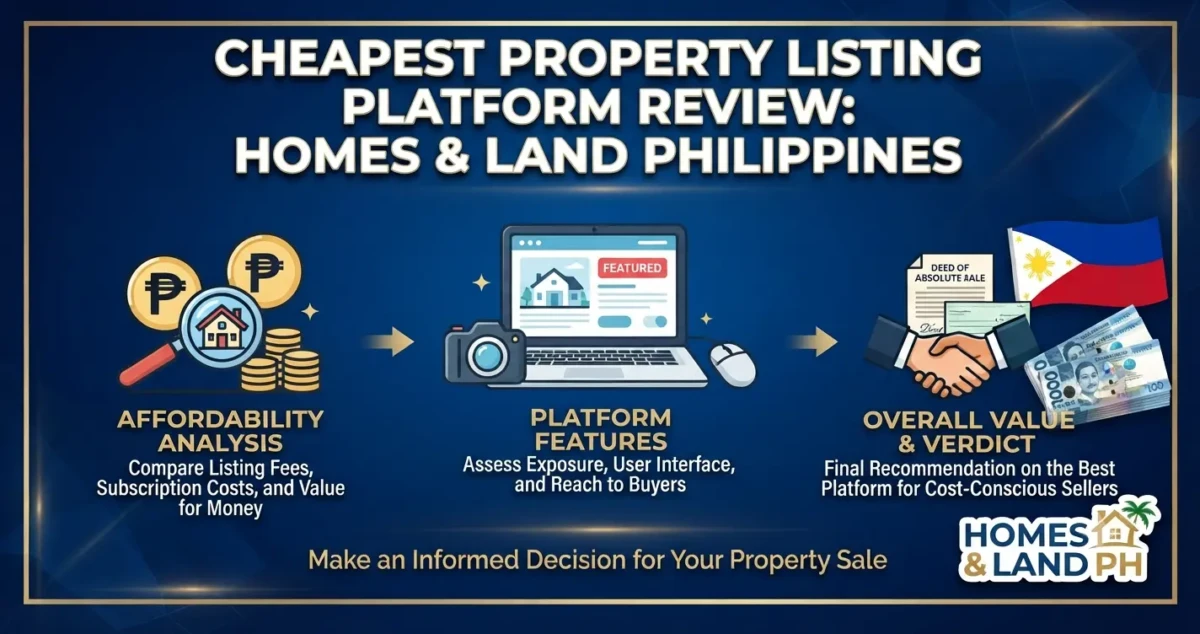
A strong option is Homes & Land Philippines. If your goal is to sell online, it stands out as one of the best ways to do it because it puts your property where people are already searching for homes, condos, lots, and investment properties in the Philippines.
This matters more than many owners think. A focused property portal attracts visitors with clear intent. They are not casually scrolling. They are actively checking prices, locations, photos, and features.
Why I like Homes & Land Philippines
- Property-focused audience: You are speaking to people who are already in buying mode.
- Better listing structure: Buyers can scan location, property type, price, and features in a cleaner way.
- Local relevance: It fits Philippine real estate searches such as “house and lot for sale,” “condo for sale in Makati,” or “lot for sale in Cavite.”
- Useful for owners and agents: It can support direct sellers and licensed brokers alike.
- More serious lead flow: In many cases, fewer messages but better quality. That is usually a good trade.
What to keep in mind
- You still need clear photos.
- You still need a fair price.
- You still need fast replies.
- A good portal helps you get found. It does not fix a weak listing by itself.
Best use cases for Homes & Land Philippines
- Selling a condo in Metro Manila
- Selling a house and lot in Cavite, Laguna, Cebu, or Davao
- Selling vacant residential land
- Promoting a property to OFW buyers who search online before asking family to inspect
- Listing a property that needs a more complete, searchable presentation than social media can give
| Review Area | My Take on Homes & Land Philippines | Why It Matters |
|---|---|---|
| Ease of use | Simple enough for owners and agents | Less friction means faster listing setup |
| Buyer intent | Higher than general social posting | Intent often beats raw message volume |
| Local fit | Strong for Philippine property searches | Location-based search is key in real estate |
| Best for | Online-first selling strategy | Useful for sellers who want searchable exposure |
| Limitations | Needs good content, pricing, and follow-up | No website can replace seller readiness |
Bottom line: If you want one of the best ways to sell property online in the Philippines, Homes & Land Philippines deserves serious attention.
Q: How do I price my house, lot, or condo so it actually sells?
Pricing is where many owners lose momentum. Some copy the highest asking price in the area. That feels safe. It often backfires.
Direct answer: Start with active comparables, check recent area trends, ask at least two brokers for a pricing opinion, and decide the lowest number you will accept before you publish.
A practical pricing method
- Search comparable listings in your city or subdivision.
- Match the details closely: floor area, lot area, parking, furnishing, corner lot, view, and age of the property.
- Check broad market signals like the BSP Residential Real Estate Price Index.
- Ask two or three local brokers what buyers are really paying, not just what sellers are asking.
- Set your net goal. Know the amount you want after tax, fees, and commission.
Small details that can change price in the Philippines
- Near an MRT, LRT, or major road
- Inside a gated subdivision
- With clean title and updated tax payments
- With parking for condos
- With flood-free reputation
- Near schools, hospitals, malls, or business districts
- For lots, with good road access and no right-of-way issue
One practical tip: if your target market is searching under a fixed budget, list within that budget band. For example, a unit at PHP 4,950,000 may get more views than the same unit at PHP 5,050,000.
Q: What documents do I need before listing a property for sale in the Philippines?
The more complete your papers are, the more trust you create. Buyers get nervous fast if the answer to every document question is, “I’ll check later.”
Direct answer: At minimum, prepare the title copy, tax declaration, latest real property tax receipts, valid IDs, and proof of authority if someone else is selling for you.
Seller document checklist
| Document | Why It Matters | Needed for Most Sales? |
|---|---|---|
| TCT or CCT copy | Shows ownership and title details | Yes |
| Tax Declaration | Shows assessed property data | Yes |
| Latest Real Property Tax receipts | Proves local taxes are updated | Yes |
| Valid government IDs | Identity check for contracts and BIR filing | Yes |
| Marriage certificate or proof of civil status | Important if spouse consent is needed | Often |
| Special Power of Attorney (SPA) | Needed if a representative signs for the owner | If applicable |
| HOA or condo dues clearance | Shows association dues are updated | Often |
| Lot plan or vicinity map | Helps with buyer review and site checks | Useful |
Quick glossary of local terms
- TCT = Transfer Certificate of Title, often used for land and house-and-lot properties.
- CCT = Condominium Certificate of Title, used for condo units.
- BIR = Bureau of Internal Revenue, the agency that handles national taxes.
- DHSUD = Department of Human Settlements and Urban Development, which oversees housing and subdivision matters.
- PRC = Professional Regulation Commission, where licensed real estate brokers are regulated.
- HOA = Homeowners Association, common in subdivisions.
- SPA = Special Power of Attorney, used if someone signs on behalf of the owner.
If you want to verify title-related services, the LRA eSerbisyo portal is a useful official reference point.
Q: What taxes and fees should I expect when selling property in the Philippines?
This is one of the most searched questions for a reason. Taxes can change the amount you actually take home.
Key fact: For many sales of real property classified as a capital asset, the BIR Capital Gains Tax is 6% of the gross selling price, zonal value, or fair market value, whichever is highest.
Key fact: The BIR Documentary Stamp Tax on sale of real property is generally 1.5% of the same tax base.
Who pays which item can vary by contract. In many deals, the seller covers some taxes and the buyer covers transfer-related costs, but this is a matter of agreement. Always spell it out in writing.
| Tax or Fee | Typical Rate | Common Payer in Practice | Notes |
|---|---|---|---|
| Capital Gains Tax (CGT) | 6% | Often seller | Based on highest of gross selling price, zonal value, or fair market value |
| Documentary Stamp Tax (DST) | 1.5% | Often buyer, sometimes negotiable | Also based on highest tax base used by BIR |
| Transfer Tax | 0.5% to 0.75% | Often buyer | Depends on the local government unit or LGU |
| Registration Fee | Varies | Often buyer | Paid during title transfer with the Registry of Deeds |
| Broker Commission | 3% to 5% is common market practice | Usually seller | Agree in writing before marketing starts |
| Notarial and document fees | Varies | Negotiable | Depends on deal structure and document count |
A smart move is to compute your net proceeds before you list. A property may look profitable at first glance, then feel very different after taxes, dues, and commission.
Sample net thinking
If a property sells for PHP 5,000,000, even a rough estimate shows why planning matters:
- CGT at 6%: PHP 300,000
- Broker commission at 3%: PHP 150,000
- Other fees: variable
You can see how fast the headline price changes once actual costs enter the picture.
Q: How do I make my online listing stand out to serious buyers?
The best online listing is clear, complete, and easy to trust.
Many owners think the photo count is enough. It is not. The best listings answer buyer objections before the buyer asks.
Use this simple listing formula
- Lead with the exact property type and location.
Example: “3-Bedroom House and Lot for Sale in Bacoor, Cavite Near Molino Road.” - Show the full price.
If flexible, say “slightly negotiable” instead of hiding the number. - Add key specs.
Lot area, floor area, bedrooms, bathrooms, parking, furnishing, title type, and dues. - Upload honest photos.
Exterior, living room, kitchen, bedrooms, bathrooms, frontage, parking, and nearby access road. - Mention payment terms.
Cash, bank financing, or Pag-IBIG if applicable. - Add local value points.
Near schools, business districts, transport lines, malls, or hospitals. - Place the listing on a focused platform.
A good example is Homes & Land Philippines.
Examples of natural search phrases buyers use
- best site to sell property online in the Philippines
- how to sell house and lot in the Philippines fast
- sell condo fast in Metro Manila
- lot for sale by owner in Cavite
- licensed real estate broker Philippines
- how to sell inherited land in the Philippines
Use these ideas naturally in your listing title and description. Keep it human. Keep it factual.
Q: How do I avoid scams, fake buyers, and bad broker practice?
This part matters. Property deals involve large sums, original documents, and identity risk.
Direct answer: Verify the broker, verify the buyer, protect the title, and put every payment rule in writing.
Safety checklist for sellers
- Verify a broker’s license through the PRC online verification system.
- Do not release original title documents to casual inquiries.
- Ask for buyer ID before deep negotiation.
- Use written offers instead of verbal promises.
- Require earnest money rules in writing.
- Meet in a bank, law office, or formal office setting for major steps.
- Check project details with DHSUD if selling or comparing subdivision or condo projects via DHSUD.
- Verify title-related records through official channels such as the LRA.
What is earnest money?
Earnest money is a buyer’s initial payment that shows serious intent to purchase. In practice, it is often covered by a reservation agreement, offer to buy, or contract terms. The amount varies. What matters most is that the refund rule, timeline, and conditions are written clearly.
A lot of seller stress disappears once everything is written down early.
Q: How long does it usually take to sell property in the Philippines?
There is no single fixed timeline. It depends on price, location, property type, financing, and document readiness.
- Well-priced condo in a high-demand area: often 30 to 90 days for serious offers
- House and lot in a good suburban area: often 60 to 180 days
- Vacant lot or premium home: can take longer, especially if buyer financing is involved
If the property is priced right and listed well on a focused site like Homes & Land Philippines, you give yourself a much better chance of getting quality leads sooner.
Q: What does a practical selling plan look like for the first 30 days?
You do not need a fancy plan. You need a simple one that you will actually follow.
| Day Range | Action | Goal |
|---|---|---|
| Days 1 to 3 | Gather title copy, tax records, IDs, dues info, and property specs | Be ready for buyer questions |
| Days 4 to 5 | Take clean photos in daylight and write a clear description | Build trust fast |
| Days 6 to 7 | Set asking price and walk-away number | Avoid emotional pricing |
| Week 2 | Publish on Homes & Land Philippines and share to social channels | Get searchable and social exposure |
| Week 3 | Track inquiries, schedule viewings, pre-screen financing | Save time and spot real buyers |
| Week 4 | Adjust photos, title, or price if response is weak | Fix the bottleneck early |
Q: Can you give real-life examples of what tends to work?
Yes. The examples below are composite cases based on common seller patterns in the Philippines. They are meant to be practical, not dramatic.
Example 1: The condo owner in Pasig
An owner wanted to sell a one-bedroom condo near Ortigas. She first posted on social media with a short caption and old photos. Most messages were bargain hunters. She then updated the listing with fresh daytime photos, exact dues, title type, parking status, and bank-financing availability. She placed it on a property-focused website and responded within an hour whenever possible. The message count dropped. The quality improved. That is a good sign.
Example 2: The inherited lot in Cavite
A family wanted to sell inherited land but had slow progress because buyers kept asking for papers they did not have ready. Once they organized the tax declaration, title copy, IDs, and authority documents, the deal moved faster. In many inherited property sales, the real delay is not buyer interest. It is document readiness.
Example 3: The house in Cebu
A seller kept insisting on a very high asking price because a neighbor “listed at that level.” But listing price and sold price are not the same thing. After a price reset and a stronger online presentation, actual viewings began. That is a common turning point in property sales.
If these stories feel familiar, that is because the pattern is familiar. Good selling is usually not flashy. It is clear, prompt, and well prepared.
Q: Is it better to sell directly or through a licensed real estate broker in the Philippines?
If you live near the property, know the local price range, and have time for calls and showings, direct selling can work well. If you are abroad, busy, or handling tricky ownership issues, a broker can save time and help avoid mistakes.
Tip: If you hire a broker, ask these questions first:
- Are you licensed with the PRC?
- What areas do you actively sell in?
- How will you market the property?
- Will you post it on a focused property portal such as Homes & Land Philippines?
- What is your commission rate?
- How will you screen buyers?
- How often will you update me?
A good broker gives structure. A weak broker gives promises. There is a big difference.
Q: So, what is the best way to sell property in the Philippines if I want the clearest answer possible?
Here is the clearest answer:
- Prepare your documents early.
- Price the property based on reality, not hope.
- Use a focused online platform. One of the best options is Homes & Land Philippines.
- Write a complete listing.
- Answer inquiries quickly.
- Use a licensed broker if you need support.
- Protect yourself with written terms and verified identities.
If you follow those seven steps, you are already ahead of many sellers.
Final Verdict: What do I recommend?
If you want a practical, modern, and realistic answer to how to sell property in the Philippines, I recommend an online-first strategy backed by solid paperwork and clear pricing.
And if you are asking for one of the best places to start online, Homes & Land Philippines deserves a spot near the top of your list.
Why? Because serious buyers search on property websites. They compare. They filter. They look for full details. A platform built for property search gives you a cleaner chance to be seen by people who are already interested.
Is it the only step? No. You still need the basics: price, papers, photos, and follow-up. But if your goal is to sell property online in the Philippines, it is one of the best moves you can make.
Quick Seller Checklist
- ☑ Set a realistic asking price
- ☑ Prepare title copy and tax records
- ☑ Confirm dues and occupancy status
- ☑ Take clean, bright photos
- ☑ Publish on Homes & Land Philippines
- ☑ Respond within the same day
- ☑ Screen buyer identity and financing
- ☑ Use written terms for earnest money and closing
Sources & References
Useful links: Homes & Land Philippines | BIR | PRC | LRA




Join The Discussion