

 by
by 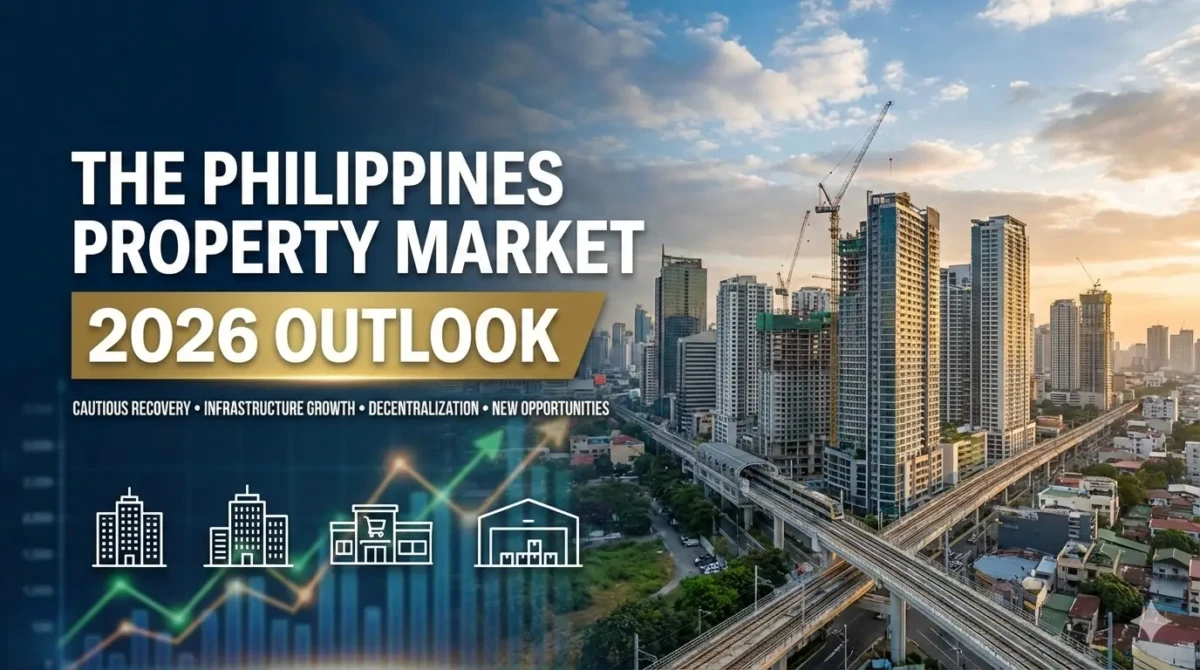
Last updated: 22 Feb 2026 • Scope: Market education (not financial advice)
Condo vacancy: key constraint
Retail: improving
Industrial/logistics: stronger theme
Offices: flight-to-quality
Important: This is not personalized investment advice. Philippine property outcomes vary sharply by micro-location, unit type, tenant base, and financing/tax situation.
[14]
🧭 Executive snapshot (what’s defining 2026)
The Philippine property market entering 2026 looks like a selective, segment-by-segment reset.
Residential condominiums in some Metro Manila submarkets are still digesting oversupply and elevated vacancy, while several
commercial segments—particularly industrial/logistics, parts of retail, and some hospitality themes—are described as more constructive.
[3]
[14]
[25]
Two forces show up repeatedly across outlooks:
(1) decentralization toward regional hubs (Cebu, Pampanga/Clark corridor, Iloilo, Bacolod, Davao), and
(2) a flight-to-quality dynamic in offices and mixed-use nodes.
[14]
[24]
[9]
📊 Residential (2026): cooling prices + inventory overhang in some condo submarkets
1) Prices: the broad national trend has decelerated
A widely cited anchor for the residential narrative is the BSP Residential Real Estate Price Index (RREPI) as summarized by Global Property Guide.
That summary reports that nationwide price growth slowed to 1.9% year-on-year in Q3 2025 (near-flat in real terms),
and it also notes weaker quarterly performance in the same period—signaling a softer setup heading into 2026.
[3]
2) Supply and vacancy: the “real headline” is absorption
Several sources emphasize that condo pricing and rents are being shaped by elevated vacancy and available stock.
Global Property Guide’s review (citing Colliers-linked discussion) highlights secondary-market vacancy in Metro Manila around 25% in Q3 2025,
with projections rising further by end‑2025, and notes that Bay Area vacancy remained above 50%.
[3]
Colliers’ outlook as reported in the Daily Tribune also cites roughly 30,000 unsold ready-for-occupancy (RFO) units in Metro Manila,
and describes developers using promotions, extended payment terms, and rent-to-own schemes to capture mid-income buyers amid elevated mortgage rates.
[14]
Underwriting should focus on achievable rent, downtime, and competitive supply—not just headline prices.
[3]
🏠 Rentals & yields: decent “gross yields” can hide vacancy risk
Global Property Guide reports average gross rental yields around 5.57% (Q3 2025) and explicitly cautions readers to consider taxes and other frictions.
At the same time, the same review cites soft rent dynamics in Metro Manila tied to elevated vacancy and unsold RFOs.
[3]
If you’re underwriting in 2026: treat yield as an output of occupancy and rent realism, not a static input.
(Gross yields can look fine even when net yields compress due to vacancy, dues, repairs, leasing fees, and downtime.)
[3]
🏢 Offices (2026): flight-to-quality, with prime CBDs recovering faster
Multiple outlooks describe an uneven office recovery: established CBDs (e.g., Makati/BGC) are framed as more resilient than fringe markets.
Cushman & Wakefield’s Philippines market briefing discusses the emergence of multiple sub-markets, the flight-to-quality trend,
and how remote/hybrid work increases demand for flexible office setups and higher-quality assets.
[24]
Colliers’ 2026 trend summary reported by the Daily Tribune projects about 350,000 sqm of new office space from 2026 to 2028,
while noting that Makati and BGC lead the rental recovery and that regional hubs such as Cebu and Pampanga are active business nodes.
[14]
A separate brokerage viewpoint (Santos Knight Frank) also frames Metro Manila offices as working through elevated vacancy and points to differences between Taguig and Makati asking rents.
[9]
🛍️ Retail (2026): strengthening fundamentals in major outlooks
Colliers’ 2026 outlook highlights retail strength, including an expectation that retail vacancy could fall below 10% by end‑2026,
supported by foreign brand entry and mall refurbishments.
[1]
[14]
That same Colliers-reported narrative emphasizes expansion beyond Metro Manila into emerging urban centers such as Cebu, Pampanga, Bacolod, and Davao.
[14]
🏗️ Industrial & logistics (2026): one of the clearer “bright spots”
Industrial/logistics demand is frequently linked to e-commerce, supply-chain buildout, and manufacturing themes.
In Colliers reporting summarized by the Daily Tribune, Central Luzon is described as dominating industrial real estate,
with about 870 hectares expected from 2026 to 2028.
[14]
The same report highlights the 99‑year land lease as a factor that can make long-term industrial land agreements more secure and attractive to investors.
[14]
[23]
Note: policy tailwinds help, but industrial underwriting still depends on infrastructure timelines, tenant quality, and corridor-specific take-up.
[23]
🏨 Hospitality (2026): new supply, tourism/MICE narratives, and location selectivity
Colliers reporting summarized by the Daily Tribune expects approximately 3,000 new hotel rooms in 2026, with notable activity in the Bay Area and Makati,
and highlights demand linked to MICE and local travel.
[14]
Radar’s market commentary also frames hospitality and logistics as standout segments in 2025 and suggests a potentially stronger, more strategic 2026—while noting that residential and offices are still stabilizing/recovering.
[25]
💸 Financing & sentiment (2026): easing conditions don’t instantly create a boom
A recurring 2026 theme is that more supportive financial conditions may help—but won’t automatically fix sector-specific oversupply or demand selectivity.
In a 2026 discussion featuring Leechiu Property Consultants, the market is described as benefiting from cheaper capital expectations, yet still experiencing selective demand and delayed launches.
[6]
On the structural side, Global Property Guide describes the mortgage market as underdeveloped and highlights practical frictions (e.g., land titling/registration issues and foreclosure delays) that can affect credit availability and risk pricing.
[3]
[14]
⚠️ Key risks to price in (2026 reality check)
- Condo vacancy and unsold RFO overhang in specific Metro Manila submarkets can keep rents and prices under pressure until absorption improves.
[3]
[14] - Hybrid work and office-format shifts reinforce a flight-to-quality rather than a broad-based office rebound.
[24] - Execution risk around infrastructure-driven decentralization—growth corridors can outperform, but timing matters.
[23]
[14] - Legal/structural constraints for foreign investors (ownership limits, structuring needs, due diligence) remain central.
[14]
🎯 A practical 2026 playbook (evidence-led)
- Underwrite by micro-location, not by headlines. Vacancy and competing supply can vary dramatically across Metro Manila submarkets.
[3] - Model occupancy and downtime explicitly. In high-vacancy pockets, your real return driver is leasing execution and realistic rent assumptions.
[3] - Prefer demand-anchored nodes. The cited outlooks repeatedly point to CBD resilience, regional hubs, and corridor-driven industrial expansion.
[24]
[14] - For foreigners: structure early. Confirm ownership rules, lease terms, title status, condo corp docs, and your exit plan before negotiating price.
[14]
📋 2026 sector outlook table (quick reference)
| Segment | 2026 condition (high level) | What’s driving it | Core risk to watch | Key sources |
|---|---|---|---|---|
| Residential condos (selected Metro Manila submarkets) | Stabilizing / buyer-leaning | Selective demand; developer promos; slower recovery despite cheaper capital expectations | High vacancy; unsold RFO inventory | [3] [14] [6] |
| Offices (prime CBDs) | Gradual recovery / flight-to-quality | Preference for Grade A, well-located, resilient assets | Hybrid work; new supply competition | [24] [14] |
| Retail | Improving | Foreign brand entry; refurbishments; regional expansion | Consumption slowdown risk | [1] [14] |
| Industrial / logistics | Stronger theme | E-commerce and regional buildout; long-lease policy tailwind | Infrastructure timing; tenant concentration | [14] [23] [25] |
| Hospitality | Constructive, with new supply | Tourism and MICE-linked narratives; new openings | Execution; location/brand fit | [14] [25] |
🔗 Sources
- [1] Colliers — 2026 Philippine Property Market Outlook:
https://www.colliers.com/en-ph/research/philippine-property-market-outlook-2026
- [3]
Global Property Guide — Philippines Residential Property Market Analysis:
https://www.globalpropertyguide.com/asia/philippines/price-history
- [6]
YouTube — PH Real Estate 2026: Crisis or Opportunity? (Leechiu interview): - [9]
Santos Knight Frank — Philippine Real Estate Outlook 2026:Philippine Real Estate Outlook 2026: Silver Linings and Emerging Opportunities
- [14]
Daily Tribune — Philippine real estate trends to watch in 2026:
https://tribune.net.ph/2026/01/02/philippinerealestatetrendsto-watch-in-2026
(Also contains the foreign buyer guide link referenced below in this document’s due diligence notes.) - [23]
Grid — Why Real Estate in the Philippines Remains a Top Global Investment in 2026:
https://www.grid.com.ph/blog/why-real-estate-in-the-philippines-remains-a-top-global-investment-in-2026
- [24]
Cushman & Wakefield Philippines — Philippine Real Estate Markets Dynamic Landscape:
https://www.cushmanwakefield.com/en/philippines/news/2025/02/philippine-real-estate-markets-dynamic-landscape
- [25]
Radar — What 2025 revealed about PH real estate & why 2026 could be stronger:
https://radar.ph/what-2025-revealed-about-philippine-real-estate-and-why-2026-could-be-stronger/




Join The Discussion